
Notes for everyone at the project table.
Practical thinking on scheduling, cost control and running construction programs in Canada.
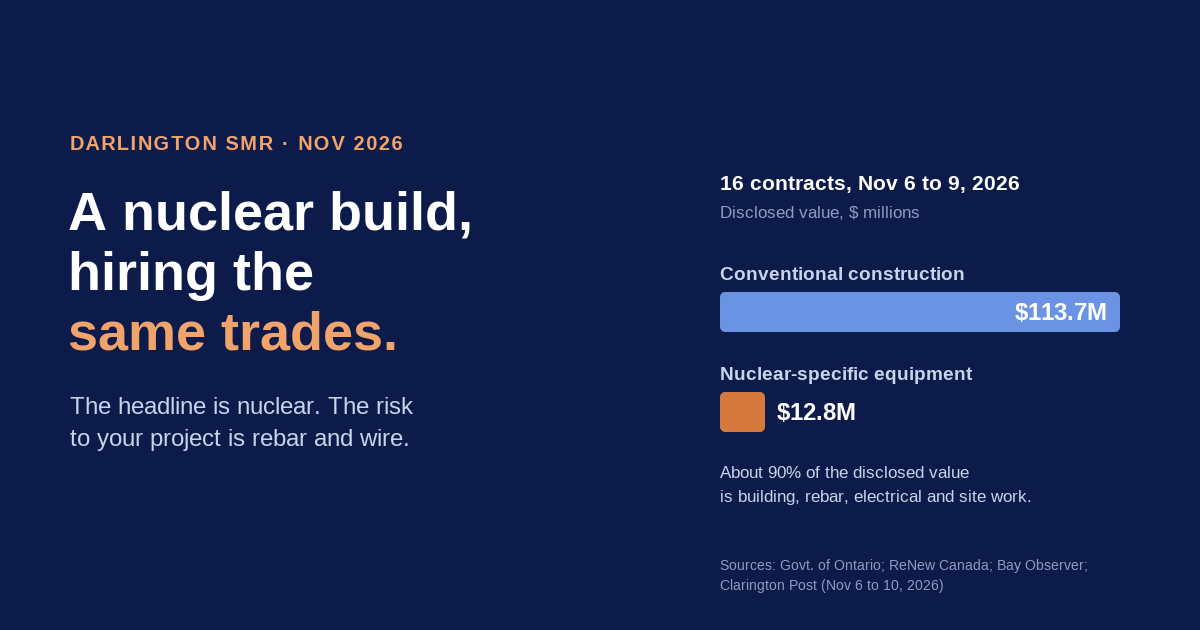
Darlington SMR Contracts: What Ontario's Nuclear Build Means for GTA Project Teams
Ontario named 16 Darlington SMR contracts in four days. About 90% of the disclosed value is ordinary construction. What it means for GTA project teams.
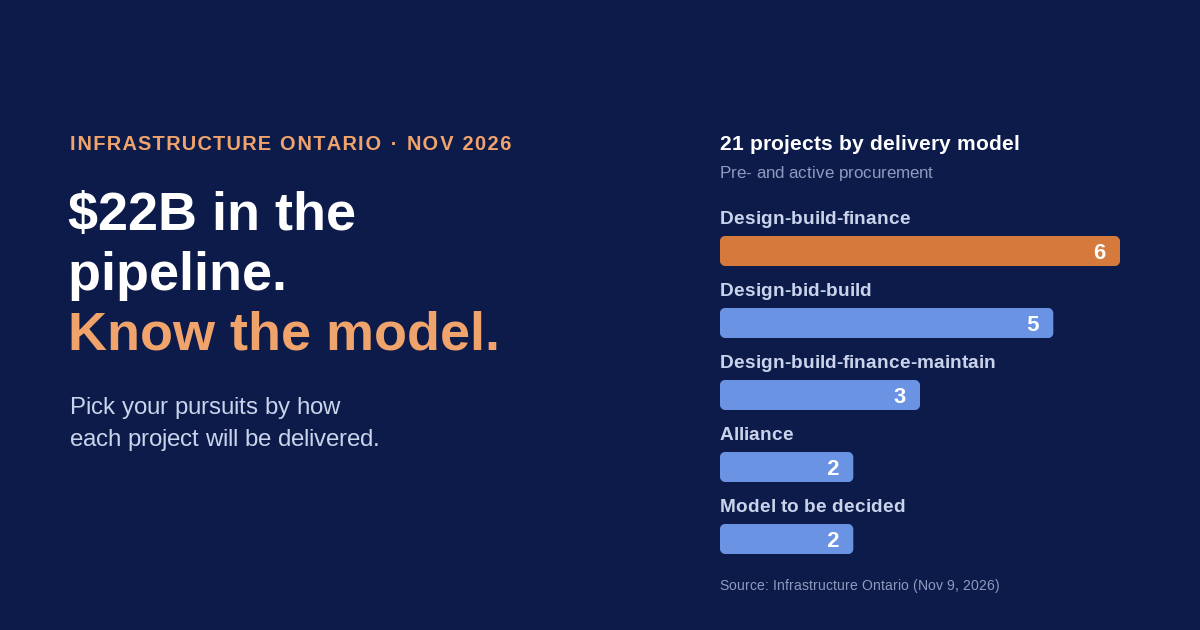
Infrastructure Ontario's November 2026 Market Update: $22B, 21 Projects and What Project Teams Should Do Now
IO's November 2026 Market Update lists 21 projects worth $22B+, 13 of them health. What it means for owners, contractors and consultants, and what to do now.
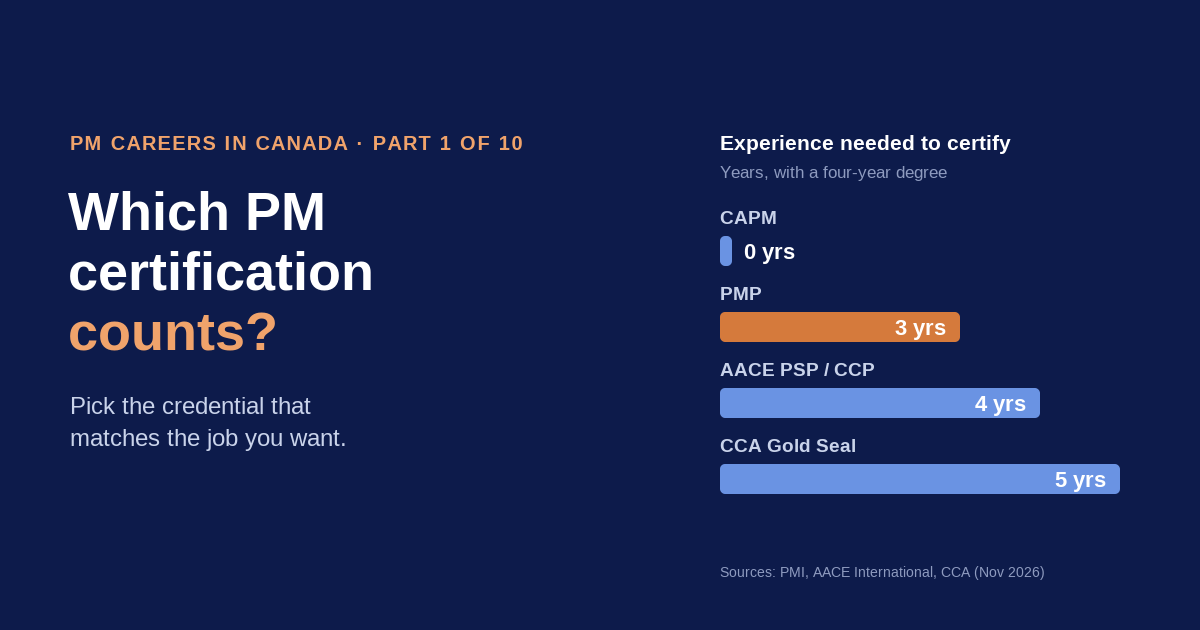
Project Management Certifications in Canada: Which Ones Count and Who They're For (2026)
PMP, CAPM, PRINCE2, IPMA, Gold Seal, PQS and AACE compared: who issues them, the experience needed and which roles each one fits in Canada.
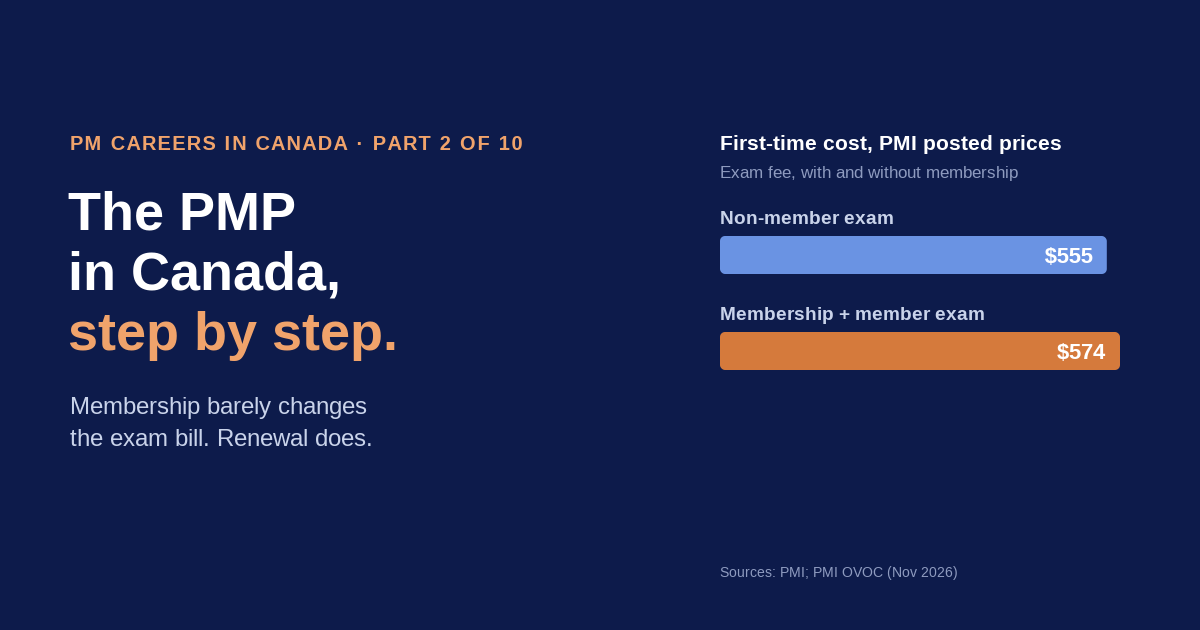
PMP Certification in Canada (2026): Requirements, Cost, Exam and Renewal
What the PMP takes in Canada in 2026: experience and training rules, PMI fees, the July 2026 exam, the new training-provider rule and renewal.
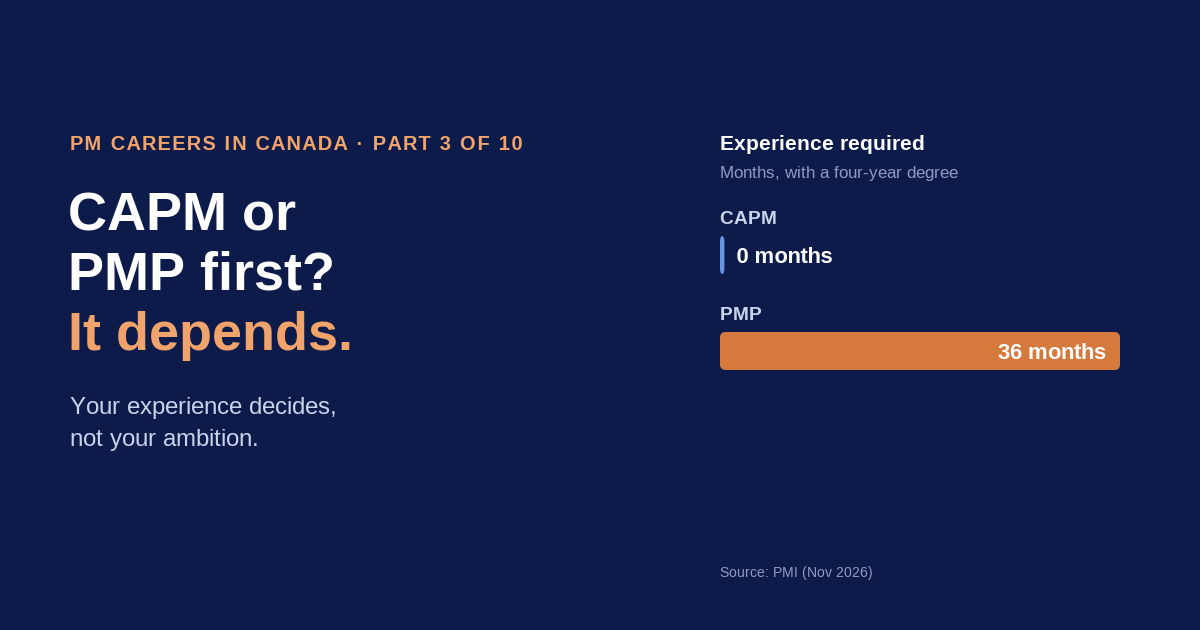
CAPM vs PMP in Canada: Which Project Management Certification Should You Get First?
CAPM or PMP? Compare experience, training, exam and renewal requirements, and see which one fits students, coordinators and working project managers.
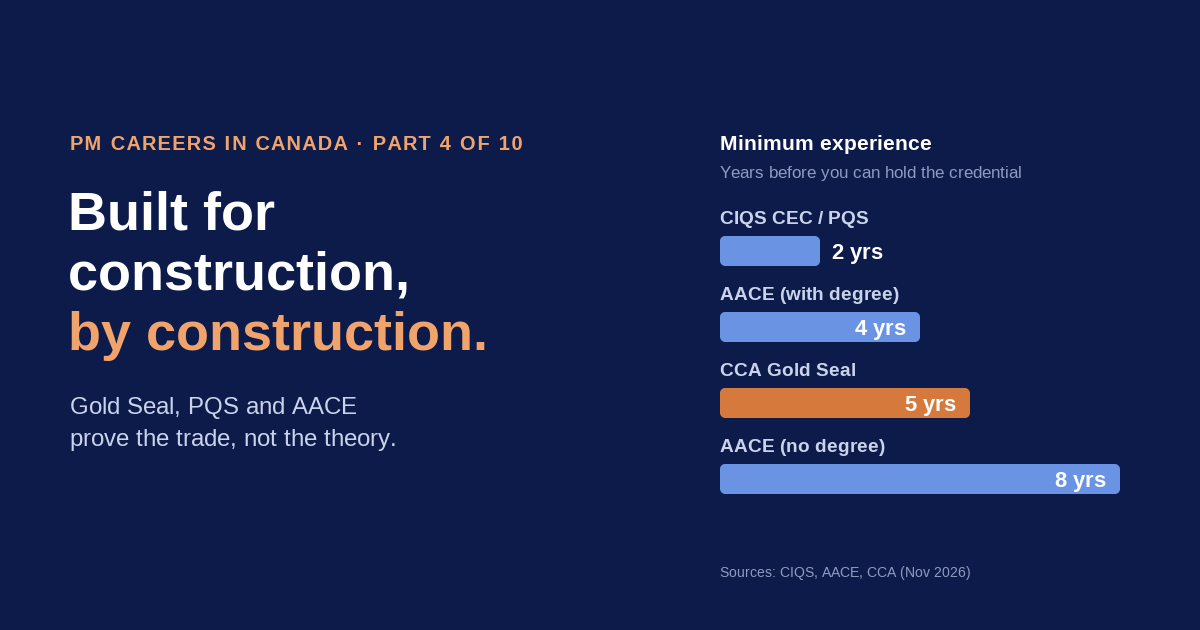
Gold Seal, PQS or AACE? Construction Project Management Credentials in Canada
Canada's construction credentials explained: CCA Gold Seal, CIQS PQS and CEC, and AACE CCP, PSP and EVP, with requirements, fees and best-fit roles.
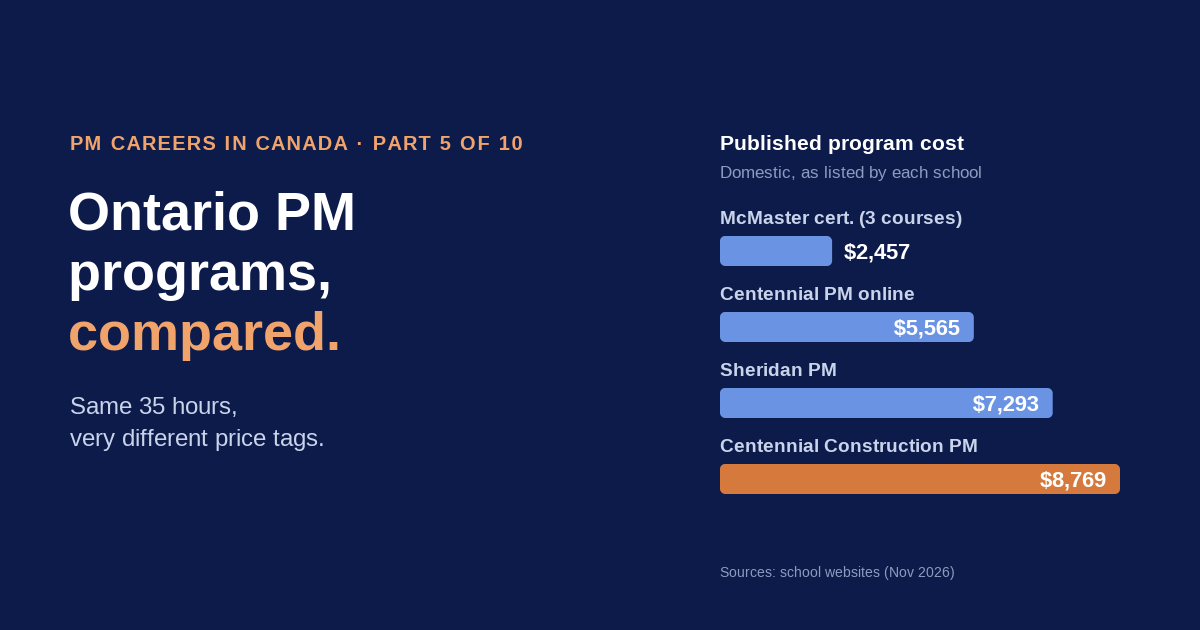
Project Management Certificate Programs in Ontario (2026): Colleges, Universities and Costs
Compare Ontario project management certificates: college graduate certificates, continuing education, construction programs, costs and PMI status.
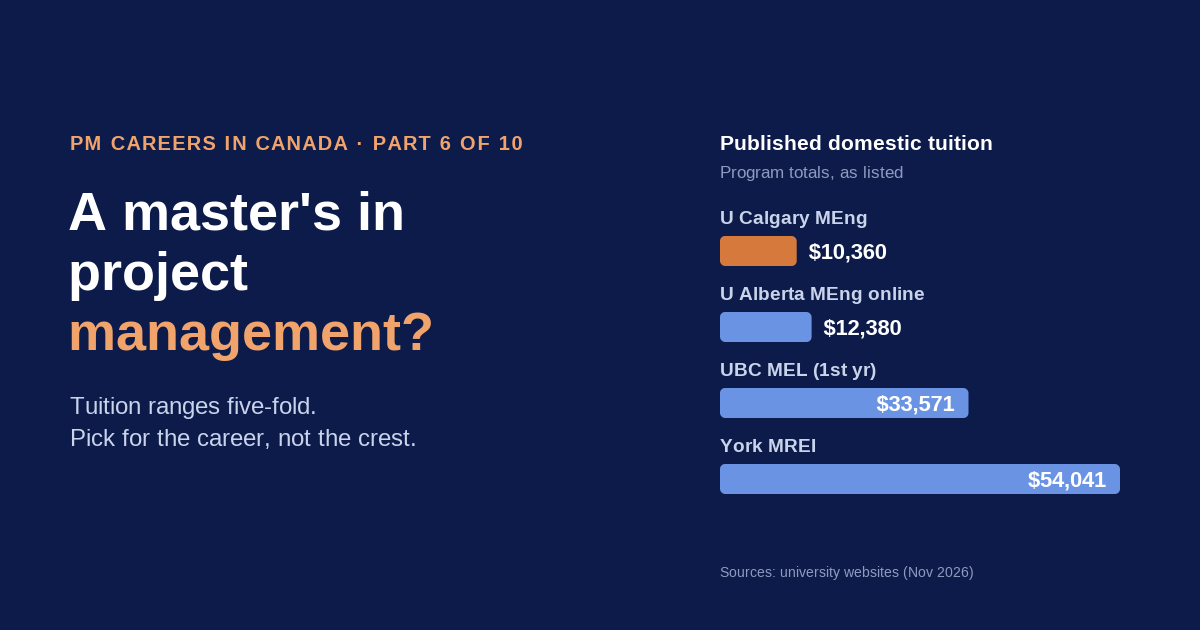
Master's in Project Management in Canada: MEng, MSc and MBA Routes Compared (2026)
Graduate options in project and construction management in Canada: Calgary, Alberta, UQAM, UBC, York and more, with length, tuition and PMP impact.
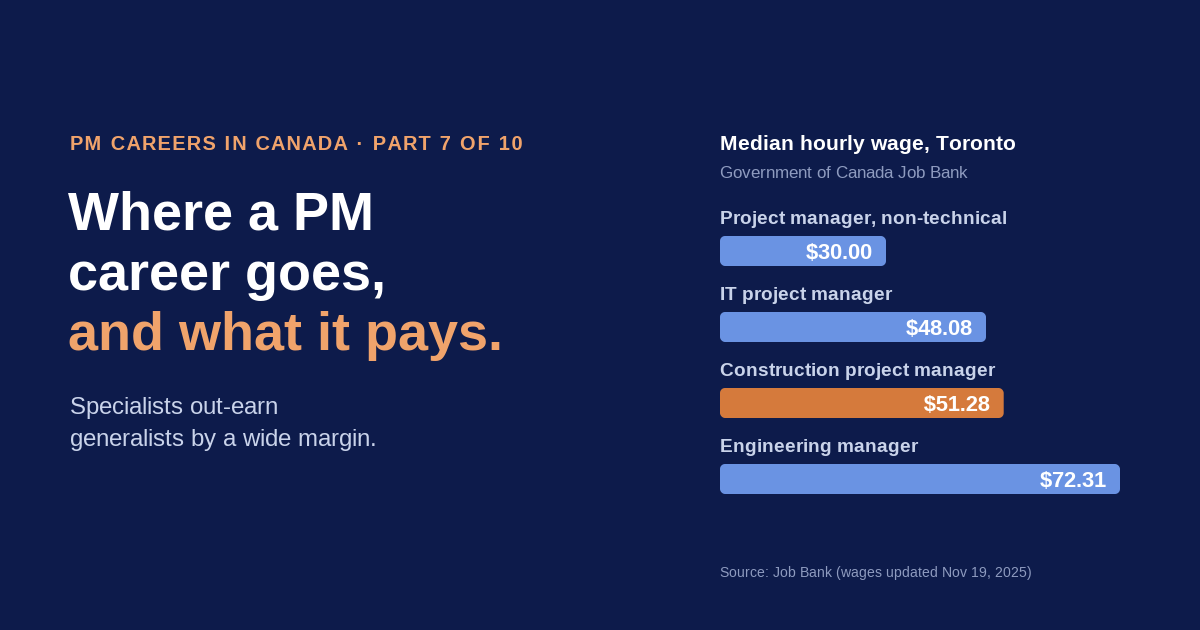
Project Manager Career Path in Canada: From Coordinator to Program Director, With Wages
How project management careers progress in Canada, from coordinator to portfolio leader, with Job Bank wages and outlooks for Toronto and Ontario.
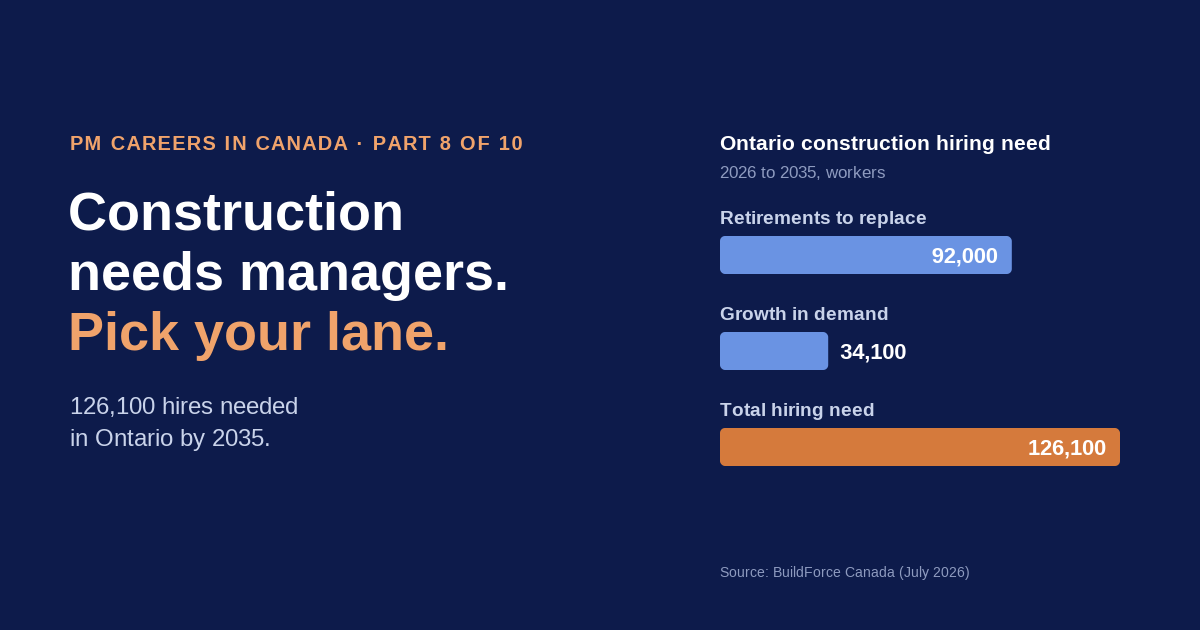
Construction Career Paths in Canada: Estimator, Scheduler, Superintendent, Project Manager and Owner's Rep
The main construction management career paths in Canada, the credentials each one uses, Toronto wages from Job Bank and why demand is set to grow.
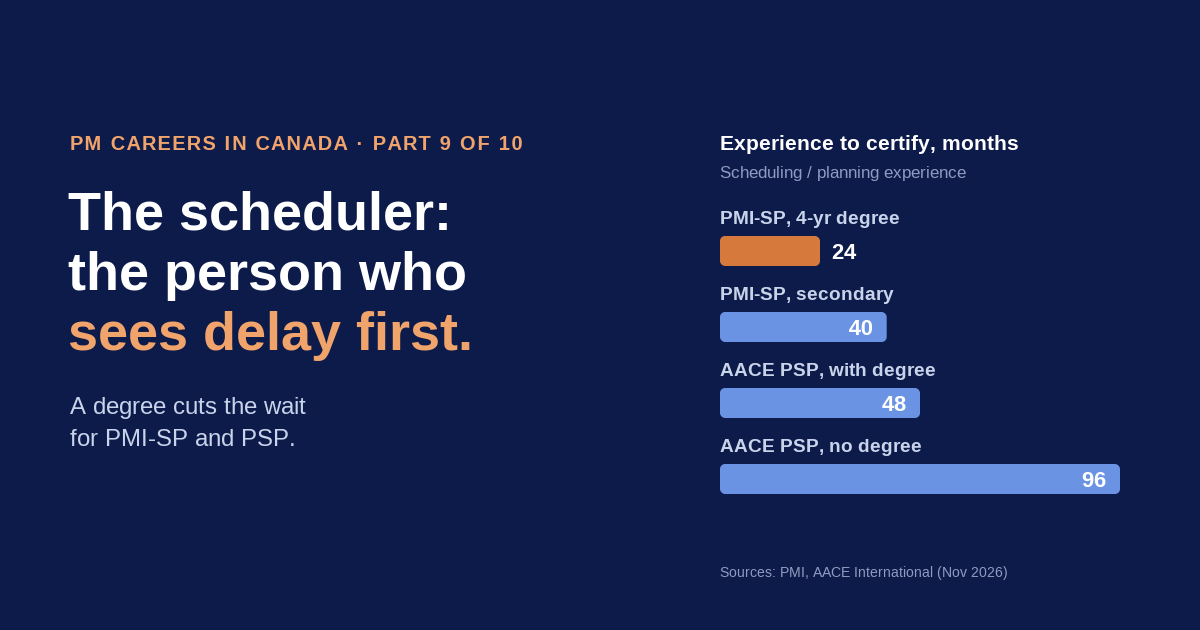
How to Become a Project Scheduler or Planner in Canada: Skills, Credentials and Pay
A practical route into construction scheduling in Canada: the skills to build, PMI-SP vs AACE PSP requirements, entry wages and how planners progress.
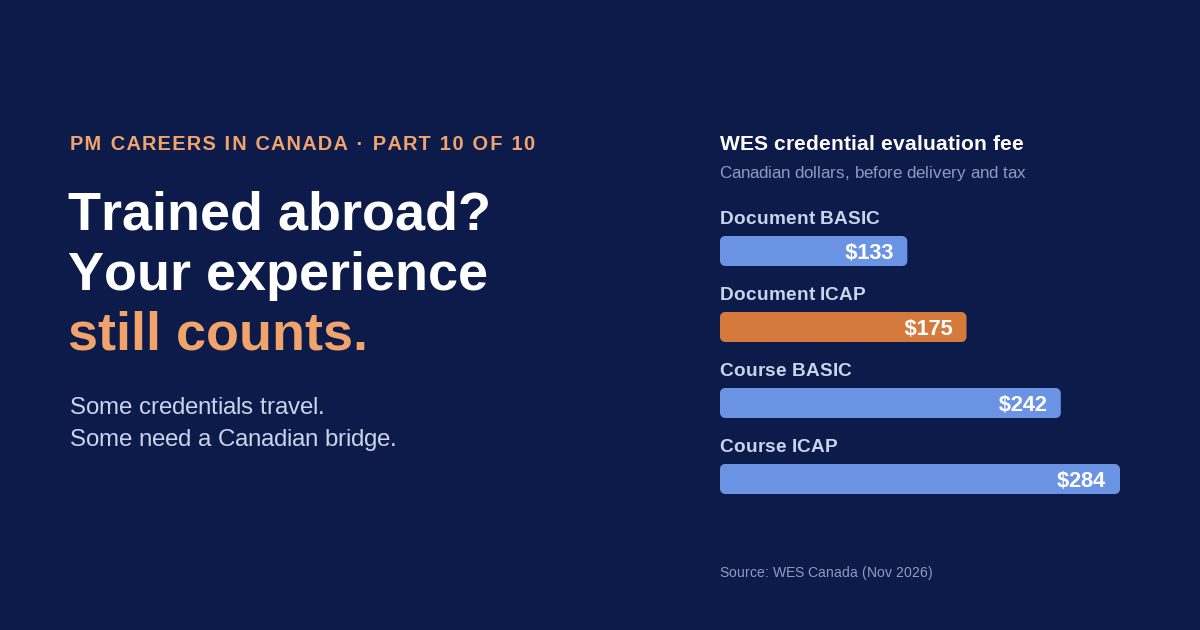
Internationally Trained Project Managers in Canada: Getting Your Credentials Recognized
For project managers trained abroad: which credentials travel, how Canadian credential assessment works, bridging programs in Ontario and what each costs.
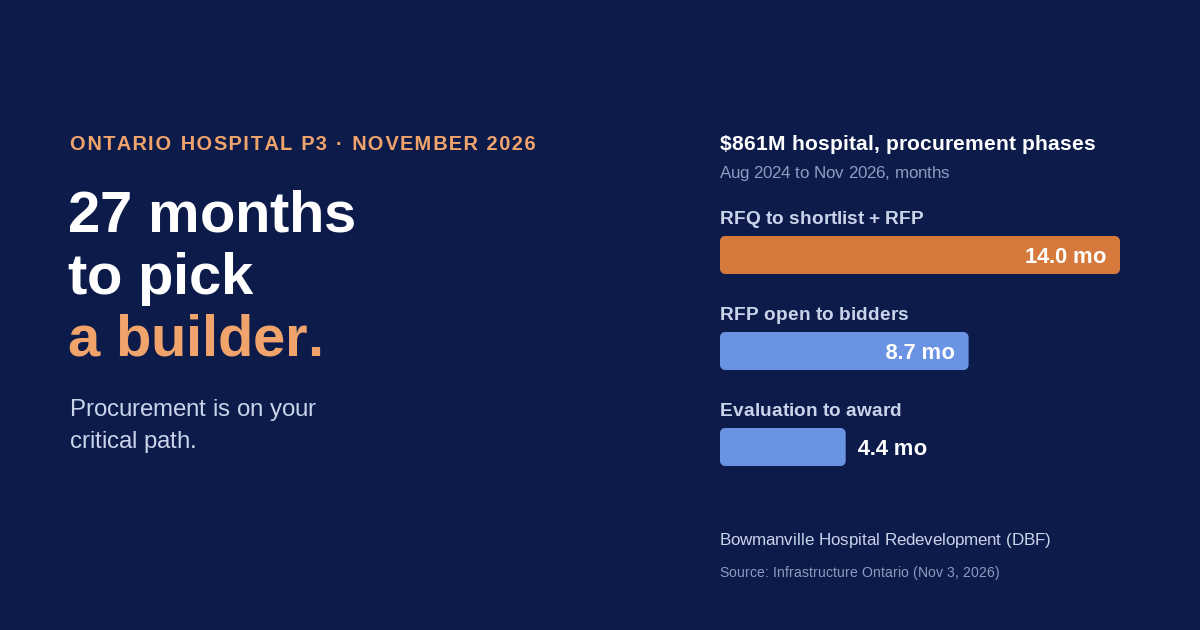
27 Months to Pick a Builder: What Ontario's $861M Bowmanville Hospital Award Teaches Owners About Procurement Time
Ontario took 27 months to procure an $861M hospital, and the RFP slipped months past plan. What owners should build into their own schedules.
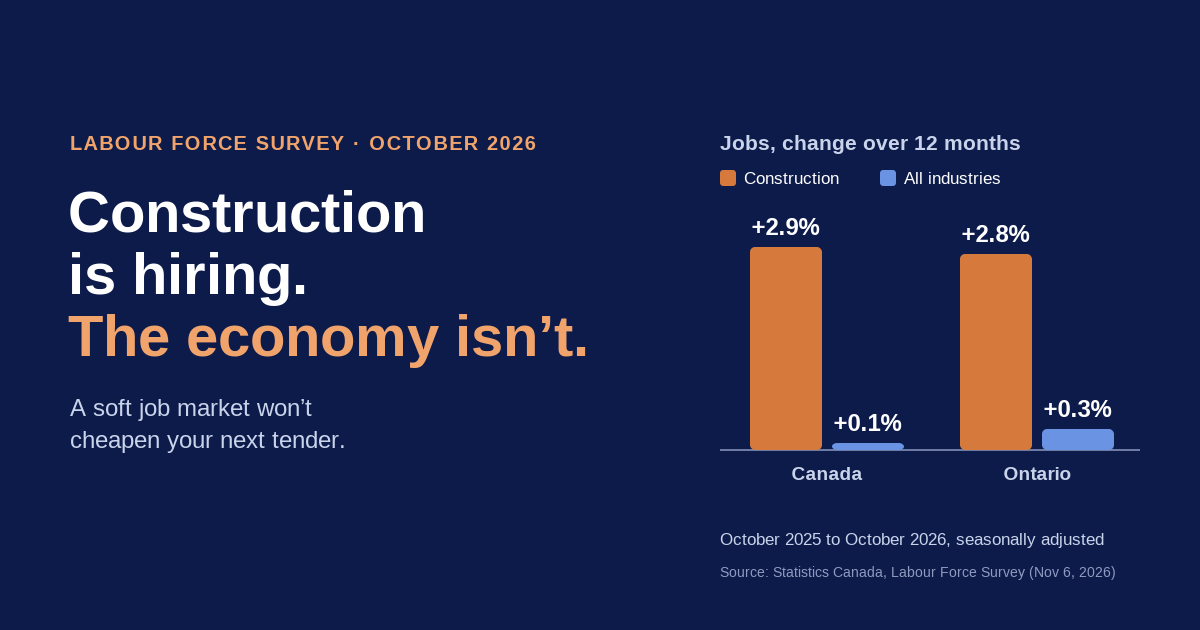
Construction Jobs Up 47,000 in a Year as Canada's Job Market Stalls: What It Means for Owners
Construction added 47,000 jobs in a year while total employment barely moved. Why a soft economy won't cheapen your 2027 bids, and what owners should do.
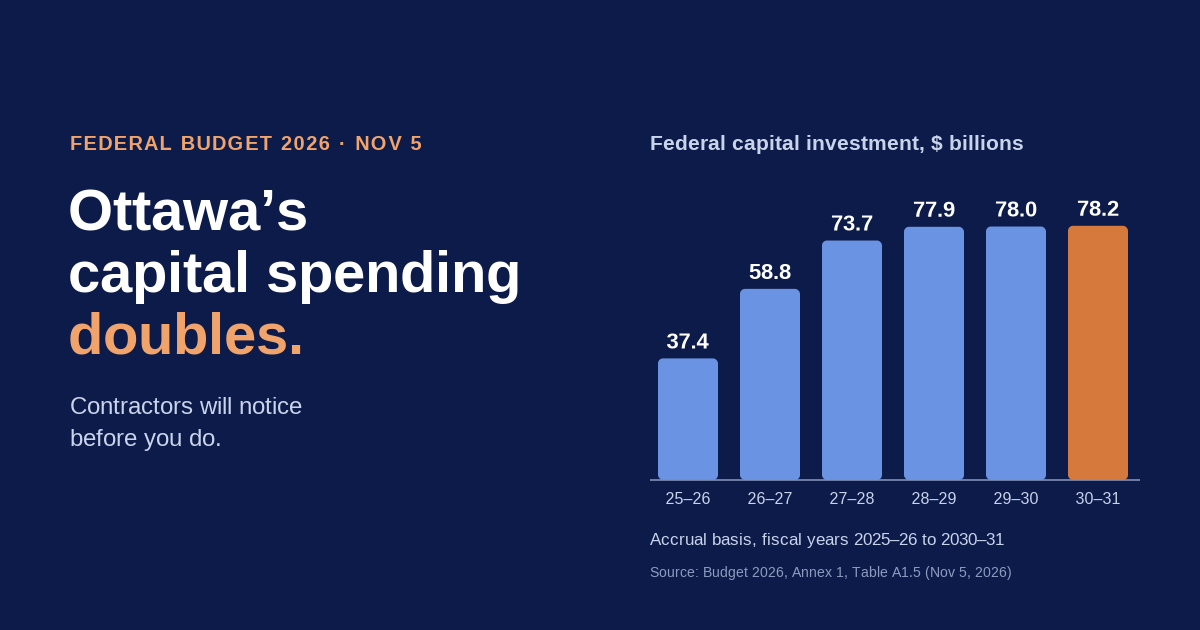
Federal Budget 2026: Capital Spending Doubles. What It Means for Construction Owners
Budget 2026 doubles federal capital investment to $78.2B a year by 2030–31. What it means for owners' tenders, escalation, trades and long-lead gear.
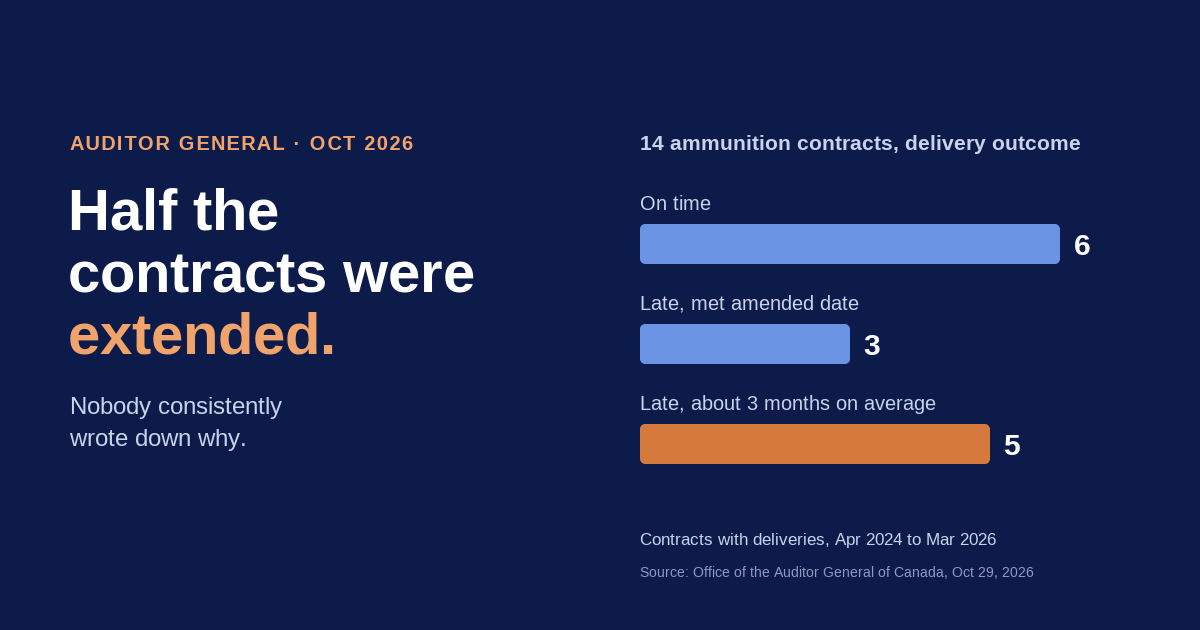
Auditor General's Ammunition Audit: 4 Procurement Lessons for Capital Program Owners
Ammunition contracts took almost 19 months and half were extended with no reason logged. What the AG's Oct 29 audit teaches capital program owners.
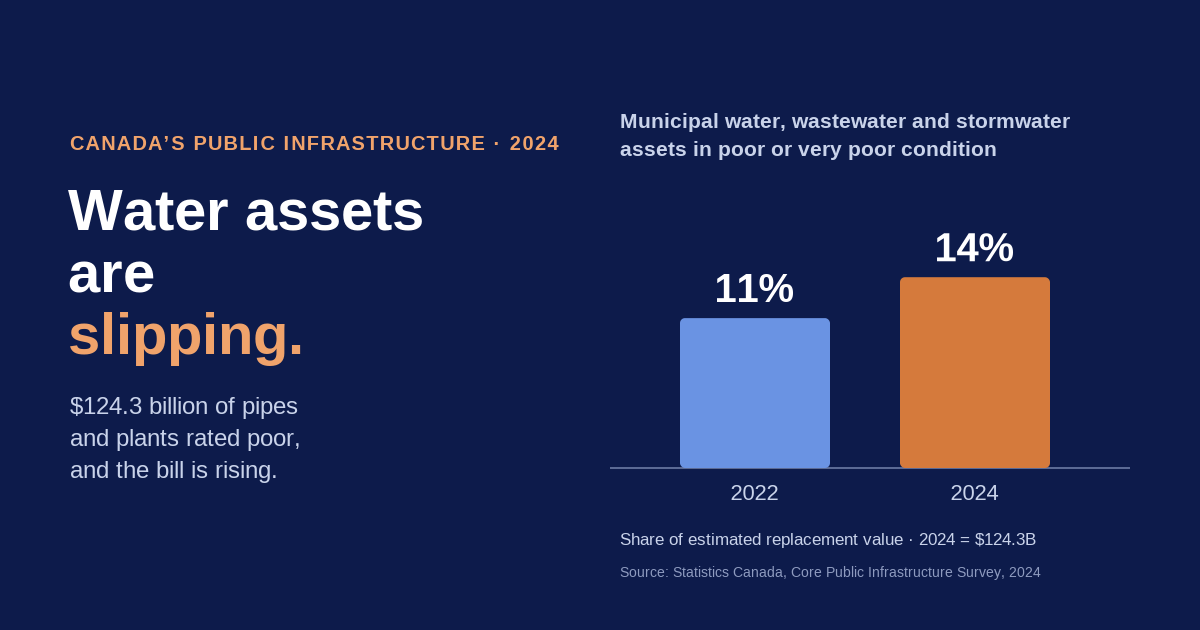
Canada's Public Infrastructure Condition 2024: $124B of Water Assets Rated Poor
StatCan's 2024 infrastructure survey: 14% of municipal water assets ($124.3B) are in poor shape. What it means for owners' sites, budgets and contractors.
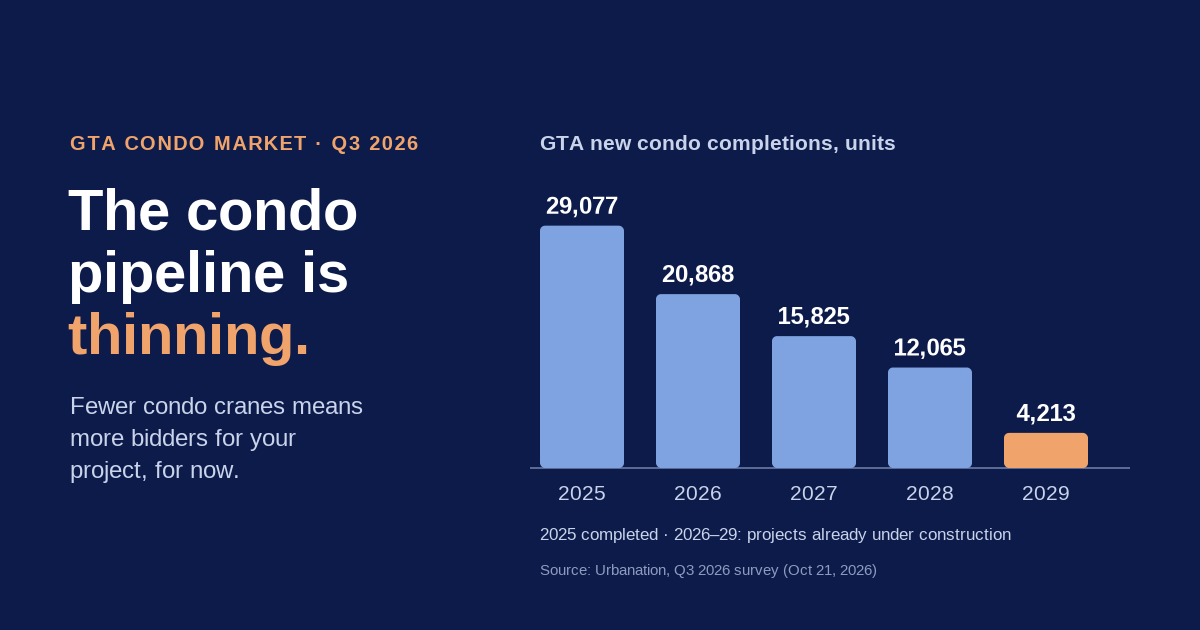
Toronto Condo Prices Fell Again in Q3 2026: What the Condo Slump Means for Construction Costs
Toronto new condo prices fell 0.8% in Q3 2026 and condo hard costs eased. What the GTA condo slump means for owners' tenders, budgets and risk.
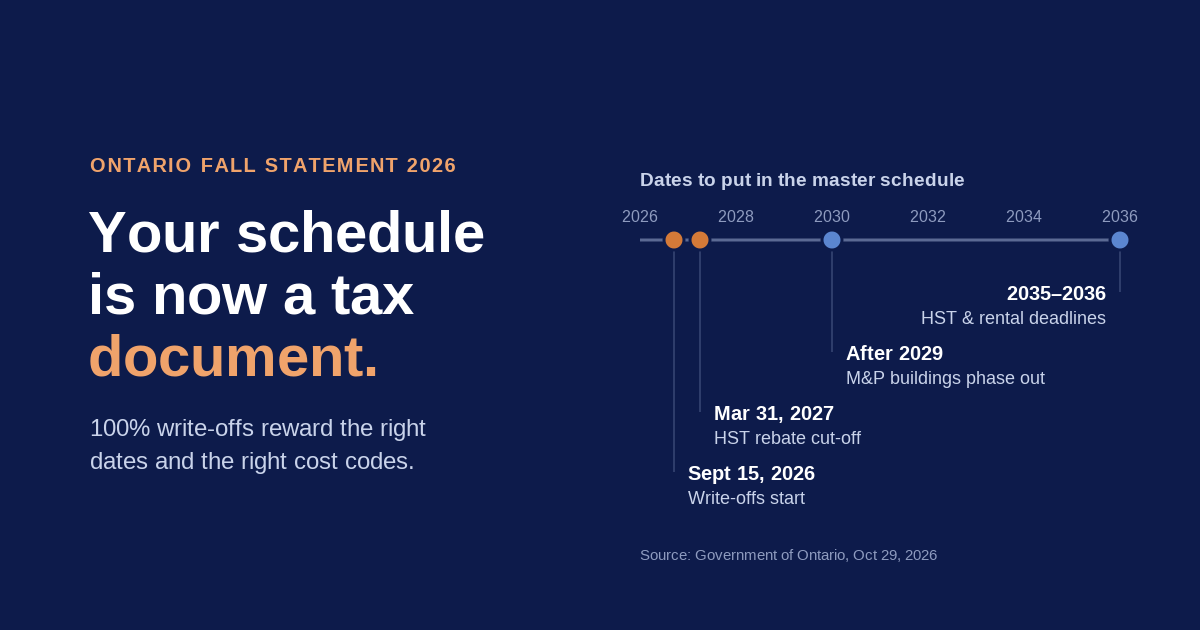
Ontario Fall Statement 2026: What the New Tax Write-Offs Mean for Building Owners
Ontario's Oct 29 fall statement: 100% write-offs for equipment, not most buildings, plus HST and rental deadlines that owners must schedule around.
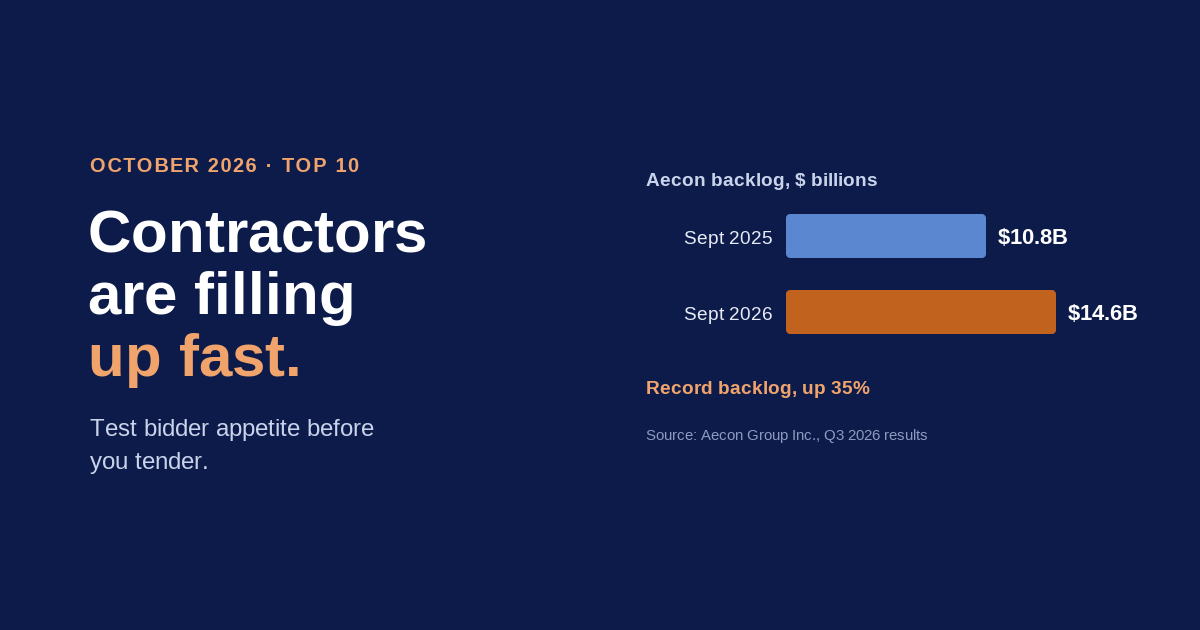
Top 10 Construction News Stories of October 2026: What Owners Need to Know
The 10 October 2026 construction stories that matter to Canadian owners: rates, Bill 140, Ring of Fire, tariffs, contractor backlogs and more.
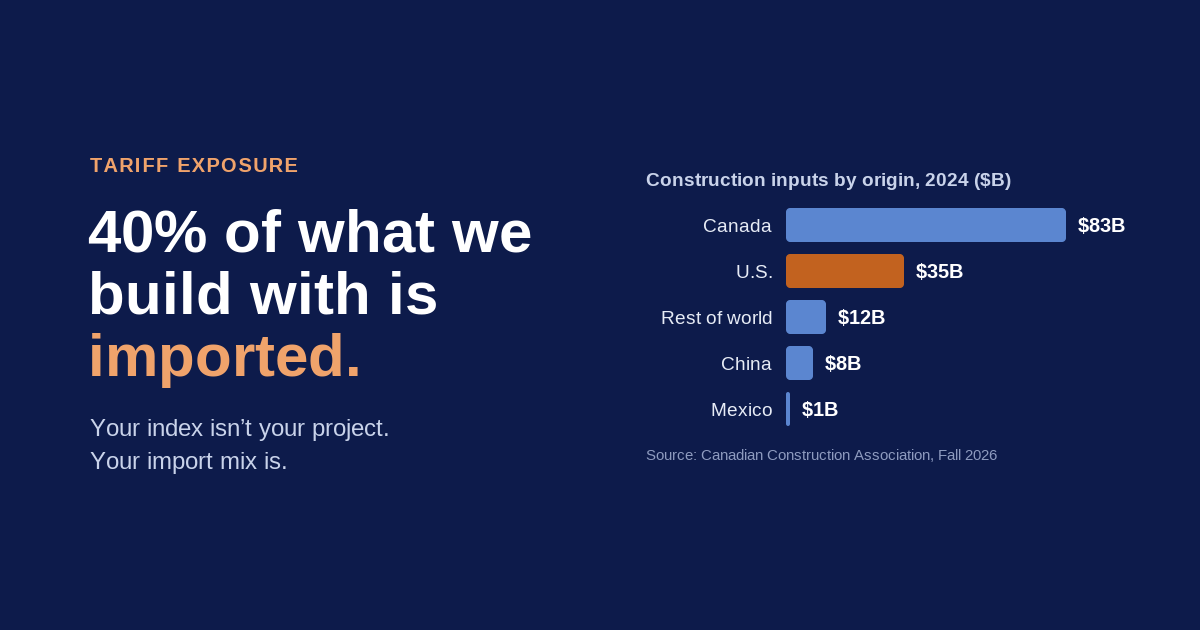
40% of Construction Inputs Are Imported: How Owners Should Stress-Test Tariff Exposure
CCA's fall 2026 report: about 40% of construction inputs are imported, 25 points from the U.S. What it means for owner budgets and what to do now.

Building Ontario Faster Act (Bill 140): What Faster Permits Mean for Owners
Ontario's Bill 140 promises nearly 220,000 days of faster permit processing. What changes, what doesn't, and how owners should plan schedules now.

Cost to Build a House in Toronto (2026): Per Sq Ft, Fees and a Worked Example
Building a custom house in the GTA costs $520–$1,130/sq ft in hard costs (Altus), before land, fees and HST. City fees and a 2,500 sq ft example.

Steps to Build a House in Ontario: From Lot to Occupancy (2026 Guide)
The 9 steps to build a house in Ontario: zoning, builder or owner-builder, design, permits, financing, locates, inspections and final occupancy.

How Long Does It Take to Build a House in Ontario? (2026)
Toronto homes built for owners take about 22 months to build (CMHC), plus 3–4 months from permit to start. Where the time goes and how to save it.

How to Finance Building a House in Canada: Construction Mortgages Explained
How construction (draw) mortgages work in Canada in 2026: draw stages, down payment, CMHC rules, the stress test, holdback and how to prepare.

Construction Costs Q3 2026: Non-Residential Up 4.3%, Steel Leads
StatCan Q3 2026: non-residential building costs up 1.2% in the quarter and 4.3% in a year, led by steel and elevators. What owners should do now.

Bank of Canada Raises Rates to 2.5%: What It Means for Construction Owners
The Bank of Canada raised its rate to 2.5% on Oct 28, 2026, its first hike since 2023. What it means for project financing, escalation and contracts.

F-35 Squadron Facilities 3 Years Late: A Recovery Playbook
Canada’s F-35 squadron facilities at Cold Lake and Bagotville are 3+ years late (2031). Why it happened, $27.7B at stake, and how to recover.

Cost to Build a Hotel, Warehouse or Parking Garage in Canada (2026)
Hotels cost $365–$565/sq ft, warehouses $75–$180, underground parking $165–$285 (GTA, Altus 2026). A 6,000 sq ft warehouse: $450K–$1.08M.

Medical Clinic Construction Cost in Toronto (2026): $460–$800 per Sq Ft
Medical clinic construction in Toronto costs $460–$800 per sq ft in 2026 (Altus, GTA hard cost). What drives clinic cost, permit timing and budget tips.
Windows Analysis Explained: Contemporaneous Period and Time-Slice Methods
Windows analysis splits a project into periods and measures critical delay in each. A worked example of contemporaneous period and time-slice methods.

Site Instruction vs Change Directive vs Change Order
Under CCDC 2, a change order fixes agreed price and time, a change directive means work now and price later, and a site instruction changes neither.

Class D Estimate: Accuracy, Contingency and When to Use It
A Class D estimate is accurate to about ±20–30% and is built from a functional program. Compare Class D vs C, B and A, and what contingency to carry.

Owner’s Rep vs General Contractor vs Construction Manager
An owner's rep works only for you; a general contractor and a construction manager build. Compare who each works for, how each is paid and when to hire.

Office Fit-Out Cost in Toronto 2026: per Sq Ft and per m²
Office fit-out cost in Toronto: $160–$265/sq ft ($1,722–$2,852/m²) for Class A and $110–$150/sq ft for Class B in 2026. What's in and out.

How Much Does It Cost to Build a Hospital in Canada? (2026)
Building a hospital in the GTA costs $1,030–$1,620 per sq ft in hard costs in 2026 (Altus). What drives the cost, plus two real Ontario hospital projects.

Buy Canadian Steel Rules: What the $5.2B Canada–Ontario Steel Deal Means for Owners
The $5.22B Canada-Ontario steel fund puts Buy Canadian and Buy Ontario steel rules in focus. What owners face on cost, schedule and contracts.

Canada Hit 2% on Defence. Can Defence Infrastructure Delivery Keep Up?
Canada reached NATO's 2% target in 2025-26. Why delivery capacity, not funding, is now the constraint on defence infrastructure, and what DND can do.

DND's Real Property Gap: Ageing Infrastructure, Military Housing and the Maintenance Deficit
DND manages Canada's largest real property portfolio. The data on condition, maintenance and housing, and five gaps owners must close to fix it.

Delivering Defence Construction in Canada: DCC, Prompt Payment, Security and Green Standards
How defence construction is delivered in Canada: DCC contracts, federal prompt payment, security clearances, Buy Canadian and green building rules.

Why Defence Capital Projects Run Late, and How Better Scheduling Fixes It
A major DND project takes about 16 years from idea to completion. Where schedules fail, and the scheduling practices that would close the gap.

Building a Defence-Ready Plant in Canada: An Owner's Guide for Manufacturers
Canadian manufacturers are expanding for defence work. Security, controlled goods, ITB, funding and schedule lessons for building a defence-ready plant.

Future Aircrew Training (FAcT) Progress: The Aircraft Are Arriving. Infrastructure Is the Next Test
Where the RCAF's $11.2B, 25-year Future Aircrew Training program stands in 2026: aircraft deliveries, facilities at three sites, and the risks ahead.

Canada's F-35 Infrastructure: The Jets Are Coming, the Squadron Facilities Are Three Years Behind
Canada's first F-35s are flying, but the Cold Lake and Bagotville squadron facilities are forecast for 2031. Where the program stands and why.

NORAD Modernization in Canada's North: Where the Infrastructure Program Stands
NORAD modernization puts $15.68B into infrastructure, from northern bases to Arctic radar. Status of each site, the schedule to 2043, and the risks.

Toronto Home Prices 2018–2026, Policy Impacts and the 2027–2028 Forecast
Toronto home prices from 2018 to 2026, how foreign buyer taxes, rates and mortgage rules moved them, and the 2027–2028 forecast for owners.
Toronto Housing Starts Fell 61% in September: What It Means for Commercial Owners
Toronto housing starts fell 61% year over year in September 2026. What CMHC's data means for commercial owners' bids, trade capacity and schedules.

AI in Canadian Construction: A Five-Year Outlook (2026–2031)
Canada's construction AI adoption against the US, China, Japan and Germany, three scenarios to 2031, and what owners should write into their contracts now.

Construction Cash Flow Forecasting: How Owners Use S-Curves
How owners forecast construction cash flow with S-curves: cost-loaded schedules, planned vs actual spend, front-loading, and funding draws.

The 10 Construction Project KPIs Owners Should Actually Track
The 10 construction KPIs owners should track: schedule, cost, change, risk, quality and safety, with definitions and the thresholds that trigger action.

Last Planner System and Pull Planning Explained for Construction Owners
The Last Planner System explained for owners: the five planning levels, how pull planning sessions work, Percent Plan Complete, and the owner's role.

Stipulated Price vs Cost-Plus vs GMP Contracts: A Guide for Canadian Owners
Stipulated price, cost-plus and GMP contracts compared for Canadian owners: who carries cost risk, when each fits, audit rights and shared savings.

Construction Management at Risk vs CM for Fee in Ontario: CCDC 5A vs 5B for Owners
CM at risk vs CM for fee in Ontario: who holds the trade contracts under CCDC 5A and 5B, what changed in 2025, and the risk and control trade-offs.

Design-Build for Owners: CCDC 14, CCDC 15 and the Owner's Statement of Requirements
Design-build for owners: how CCDC 14 and 15 work, writing the owner's statement of requirements, bridging documents and the risks of design control.

Progressive Design-Build, Alliancing and IPD in Canada: What Owners Need to Know
Progressive design-build, IPD and alliancing in Canada: CCDC 32 and CCDC 30 explained, how risk pools work, and when collaborative models suit owners.

Change Directive vs Change Order Under CCDC 2: What Owners Need to Know
How a CCDC 2 change directive differs from a change order, how directive work is valued, when to use each, and how owners keep directives under control.

How to Evaluate a Contractor's Delay Claim: An Owner's Guide to Entitlement and Quantum
How owners should review a contractor's delay claim: notice, entitlement, causation, prolongation costs and the tactics that most often inflate the total.

Construction Liens in Ontario: What Owners Need to Know
Ontario construction liens for owners: who can lien, the 60- and 90-day deadlines, why exposure is usually the holdback, and how to vacate a lien.

Substantial Performance in Ontario: Certification, Publication and What Follows
Ontario's substantial performance test, who certifies it, why publication matters, holdback timing, and how CCDC 2 Ready-for-Takeover differs.

Ontario Construction Adjudication: What Owners Should Expect
How Ontario construction adjudication works for owners: ODACC, what disputes qualify after 2026, the 30-day timeline, interim binding decisions, and prep.

Liquidated Damages in Canadian Construction Contracts: How Owners Set a Rate That Holds Up
How Canadian courts treat liquidated damages in construction: penalty vs genuine pre-estimate, LDs vs actual damages, caps and setting a defensible rate.

CCDC 2 Supplementary Conditions: What Owners Commonly Amend and What It Costs
What owners most often amend in CCDC 2 through supplementary conditions, from schedule and insurance to delay and payment, and how it affects bid prices.

Construction Bonds for Owners in Canada: Bid, Performance and Payment Bonds
Bid, performance and labour and material bonds explained for Canadian owners, Ontario's public-sector bonding rules, and how to make a bond claim.

Construction Price Escalation Clauses: Index-Based Adjustment, Thresholds, Caps and Tariffs
How construction price escalation clauses work in Canada: Statistics Canada indexes, thresholds, caps, two-way adjustment and tariffs under CCDC 2.

Construction Estimate Classes in Canada: Class D, C, B and A Explained for Owners
Class D, C, B and A construction estimates explained: accuracy ranges, how they map to AACE Class 5 to 1, and what owners must provide.

How to Calculate a Construction Escalation Allowance (With a Toronto Worked Example)
How owners calculate construction escalation: base date, midpoint of construction, Statistics Canada price indexes and a worked Toronto example.

Total Project Cost vs Construction Cost: The Soft Costs Owners Forget
Why total project cost is far more than the construction price: design fees, permits, development charges, FF&E, IT, financing and contingency.

Value Engineering Done Right: A Guide for Building Owners
What value engineering really is, how function analysis works, when to hold a VE study, and how owners should evaluate VE proposals.

Life-Cycle Cost Analysis for Buildings: An Owner's Guide With a Worked Example
How life-cycle cost analysis works for buildings: present value, discount rates, study periods, NIST Handbook 135, ISO 15686-5 and a worked example.

Construction Tender Strategy for Owners: Open, Invited or Two-Stage Tendering in Ontario
Open, invited or two-stage tendering? How Ontario owners choose a tender strategy, what Contract A means, and how trade packages and bid depositories work.

Bid Levelling: How Owners Compare Construction Tenders Properly
How to level construction bids: compliance first, scope matrices, exclusions, allowances, alternates and unit prices, with a worked example.

Preconstruction Services and Early Contractor Involvement: An Owner's Guide
What preconstruction services include, how owners procure early contractor involvement, common fee structures and how to avoid lock-in on price.

Long-Lead Equipment Procurement for Owners: Switchgear, Transformers, Elevators and RTUs
How owners manage long-lead equipment: current switchgear and transformer lead times, owner pre-purchase, assignment to the contractor and tracking.

Cost Breakdown Structure, WBS and Cost Codes for Construction Owners
How owners structure construction costs: WBS vs cost breakdown structure, UniFormat vs MasterFormat, owner vs contractor codes, and program roll-up.

Cash Allowances in Construction Contracts: How They Work Under CCDC 2
How cash allowances work under CCDC 2 (2020): what they include, overhead and profit, reconciliation by change order, and the cost of under-allowances.

Cost Control on Multi-Site Retail Rollouts: Prototype Budgets, Benchmarks and National Accounts
How owners control cost on retail rollouts: split prototype budgets, benchmark unit costs, use national accounts and separate site and prototype changes.

How to Write Owner's Project Requirements (OPR): A Guide for Building Owners
What goes into an Owner's Project Requirements (OPR), how it drives commissioning under ASHRAE Guideline 0, and how owners keep it current.

Stage-Gate Governance for Capital Projects: Gates, Decisions and What Each Gate Needs
How stage gates work on capital building projects: the six gates, who decides, what evidence each gate needs, and how owners avoid rubber-stamp gates.

A Construction Risk Register Owners Actually Use: Structure, Scoring and Contingency
How owners build a construction risk register that works: key columns, probability-impact scoring, risk owners, responses and the link to contingency.

RACI for the Owner-Side Construction Project Team: Decision Rights and Approvals
How owners build a RACI chart for their construction project team: decision rights, approval limits, delegation of authority and the gaps to close.

Capital Program Dashboards for the Board: What to Show and How to Set RAG Rules
What a board-level capital program dashboard should show: portfolio totals, RAG status rules tied to authority, exception reporting and portfolio views.

Building Commissioning and Turnover: An Owner's Guide to Getting the Building You Paid For
Building commissioning for owners: CSA Z320, ASHRAE Guideline 0, the commissioning authority's role, functional testing, systems manuals and training.

Construction Closeout and Deficiency Lists: An Owner's Checklist for Ontario Projects
How owners run deficiency lists, size a deficiency holdback separate from the 10% statutory holdback, and the closeout documents to collect in Ontario.

Construction Lessons Learned That Actually Change the Next Project
How owners capture, code and apply construction lessons learned so they change templates, standards and the next project, not just a close-out report.

Owner-Supplied FF&E and Equipment Coordination: OFOI, OFCI and CFCI Explained
How owners coordinate owner-supplied FF&E: OFOI, OFCI and CFCI responsibility matrices, delivery and storage, schedule integration and warranties.

AI in Construction Project Controls: Practical Uses, Limits and Data Risks for Owners
Where AI helps construction project controls today: schedule checks, document review, forecasting and risk, plus the limits and data rules owners need.

RFIs and Submittals: What Construction Owners Should Monitor Every Month
What owners should track in RFI and submittal logs: ageing, turnaround, resubmittal rates and critical items, and why late reviews become owner delay.

Renovating an Occupied Building: How Owners Keep Operations Running During Construction
How owners renovate occupied buildings: phasing, swing space, shutdown plans, infection control (CSA Z317.13), after-hours work and communication.

Three-Week Look-Ahead Schedules: How Owners Use Short-Range Planning to Catch Delays Early
What a construction look-ahead schedule is, how make-ready and constraint logs work, and how owners use it to keep decisions off the critical path.

Schedule Risk Analysis and Monte Carlo Simulation, Explained for Construction Owners
Schedule risk analysis explained for owners: Monte Carlo simulation, merge bias, P50 vs P80 dates, risk drivers, and when to ask for one.

Recovery Schedules and Acceleration: Who Pays to Get a Late Project Back on Track?
Mitigation vs acceleration, constructive acceleration claims, what a credible recovery schedule includes, and how owners avoid paying for the wrong delays.

How to Build a Master Schedule for a Multi-Site Construction Program
How owners structure a program master schedule for multi-site rollouts: site templates, readiness gates, shared dependencies and one-page reporting.

Construction Cost Forecasting for Owners: Estimate at Completion (EAC) and Estimate to Complete (ETC)
How owners forecast final construction cost: bottom-up forecasts, CPI, SPI and composite EAC formulas, TCPI checks and why boards need a range.
Critical Path Method Explained for Owners: How to Read the Schedule That Runs Your Project
The Critical Path Method explained for owners: forward and backward passes, float, a worked example, and how to read a contractor's CPM schedule.

Who Owns the Float? Total Float, Free Float and Construction Delay Claims
Total float vs free float, who owns float in a construction schedule, and how owners can protect themselves from float disputes and delay claims.
How to Set and Lock a Construction Schedule Baseline: An Owner's Guide
How owners should set, accept, lock and re-baseline a construction schedule, and the baseline mistakes that weaken an owner's position in delay claims.

Construction Delay Analysis Methods Explained: TIA, Windows, As-Planned vs As-Built and More
Delay analysis methods explained for owners: as-planned vs as-built, impacted as-planned, time impact and windows analysis, and collapsed as-built.

Concurrent Delay in Canadian Construction: What Owners Need to Know
Concurrent delay explained for Canadian owners: true concurrency vs concurrent effect, time vs money, Schindler v Walsh, and contract and records tips.

Construction Spending Is Up 7.9%, but Only 4.7% Is Real Growth: What It Means for Owners
Canadian building investment rose 7.9% in a year, but only 4.7% after inflation. What August 2026 data means for owner budgets, bids and tenders.
Tariff Costs Are Coming to Your Next Tender: What the Bank of Canada's Q3 Survey Means for Owners
Half of Canadian firms plan to pass on tariff and oil costs. What the Bank of Canada's Q3 2026 survey means for owner budgets, tenders and contracts.

Ontario Prompt Payment Rules for Owners: The 7-14-28 Day Clock
Ontario prompt payment rules for owners: proper invoices, the 7-day deficiency notice, 14-day notice of non-payment, 28-day payment and adjudication.

Construction Holdback in Ontario: 10% and the New Annual Release Rules
Construction holdback in Ontario: the 10% rule, mandatory annual release since 2026, the 60-74 day payment window and steps at substantial performance.

How to Manage Construction Change Orders: An Owner's Guide
How to manage construction change orders as an owner: causes, pricing review, CCDC Change Orders vs Change Directives, approval thresholds and tracking.

How Much Construction Contingency Should an Owner Carry?
Design contingency, construction contingency, escalation and owner's reserve are different pots. Published benchmarks and drawdown rules for owners.

CCDC 2 vs CCDC 5B (and 5A, 3): Which Contract Should an Owner Pick?
CCDC 2 vs CCDC 5B, 5A and 3 for owners: how stipulated price, cost plus and construction management contracts allocate risk, and when to use each.

How to Review a Construction Schedule: An Owner's Baseline Checklist
How to review a construction schedule before you accept it: critical path, float, logic, constraints, durations and updates, with DCMA 14-point thresholds.

Earned Value Management for Construction Owners, Explained Simply
Earned value management for construction owners: PV, EV, AC, CPI, SPI and EAC explained with a worked example, plus what to ask your contractor for.

Toronto Building Permit Timeline for Commercial Projects: What to Plan For
Ontario sets 10 to 30 business days to review a Toronto building permit, but only once it's complete. What commercial and retail owners should schedule.

How to Prequalify a General Contractor in Ontario: An Owner's Checklist
How to prequalify a general contractor in Ontario: CCDC 11, bonding, WSIB clearance, insurance, COR safety, references and judging bids beyond price.

Construction Project Monthly Report Template: What Executives Need
A construction project monthly report template for owners and boards: forecast at completion, contingency, milestones, risks, change orders and cash flow.

Canada's Inflation Hit 3.1% in September: What It Means for Construction Costs
Canada's inflation rose to 3.1% in September on energy prices. What fuel costs mean for construction budgets, tenders and escalation in Ontario.

A 19% Overrun on a $13M Road Job: What Hamilton's Audit Teaches Owners About Cost Control
Hamilton's auditor traced a 19% overrun on a $13.32M road contract to weak oversight. Five cost control lessons for Ontario owners.

Ontario Building Permits Rose 9.4% in August: What Owners Should Do Now
Ontario building permits rose 9.4% to $5.1B in August 2026, led by multi-unit housing. What it means for owners' budgets, bids and schedules.

What Does an Owner's Rep Cost in Ontario? (And What It Saves)
What an owner's representative costs in Ontario, how fees are structured, and the math on what independent oversight saves in change orders and delays.

Owner's Rep vs. Project Manager: Who Actually Works for You?
Every PM on a construction program serves whoever pays them. Learn who works for the owner, signs you need an owner's rep, and what to ask before hiring.

Microsoft Project Alternatives in 2026: Prices and Best Fit
Microsoft Project alternatives in 2026: ProjectLibre (free), Smartsheet, monday, Asana, Primavera P6, from $9/user/month vs $30 for Project Plan 3.

Unlocking the Complexity Advantage: A New Era of Business Adaptability
What complexity science teaches leaders about adaptability, self-organizing teams and resilience, and how to apply it to projects and organizations.

What makes construction project managers in high demand across Canada?
Housing, infrastructure and complex builds are driving demand for construction project managers across Canada. Here is what that means for owners.

How to Manage Multiple Commercial Projects Without Losing Control (Use Cases)
Nine practical strategies for owners running several commercial construction projects at once: one system, realistic schedules, budget control and risk.

Top Canadian Infrastructure Projects in 2024: Transforming Canada’s Future
From Site C to GO Expansion and the Bruce Power refurbishment: the multi-billion-dollar projects that defined Canadian infrastructure in 2024.

What are the Essential Techniques for Successful Project Management?
Communication, planning, risk management, resource allocation and adaptability: the core techniques that keep projects on time and on budget.

Do you use the right project management software?
How to choose project management software that fits your team: the features that matter, plus the strengths and gaps of popular tools.

Businesses wasted 11.4% of every dollar invested in projects in Canada
PMI found 11.4% of project investment is wasted through poor performance. What drives the loss, and how disciplined project management protects your budget.

3 Tips to Manage Construction Mistakes
Mistakes on site are inevitable. How you handle them decides cost and reputation. Three steps to own, document and fix errors before they become disputes.
Have a program that's slipping, or about to start?
Book a 30-minute call. We'll tell you where your schedule and budget are exposed, and what an owner's rep would change, before you commit to anything.