
AI in Canadian Construction: A Five-Year Outlook (2026–2031)
Impact today, international benchmarks, and what owners should do next
- 9.2%of Canadian construction firms use AI, against 19.2% of all businesses
- −37%residential building productivity, 2001 to 2023
- C$28–35Ba year of value at stake from AI and automation by 2030
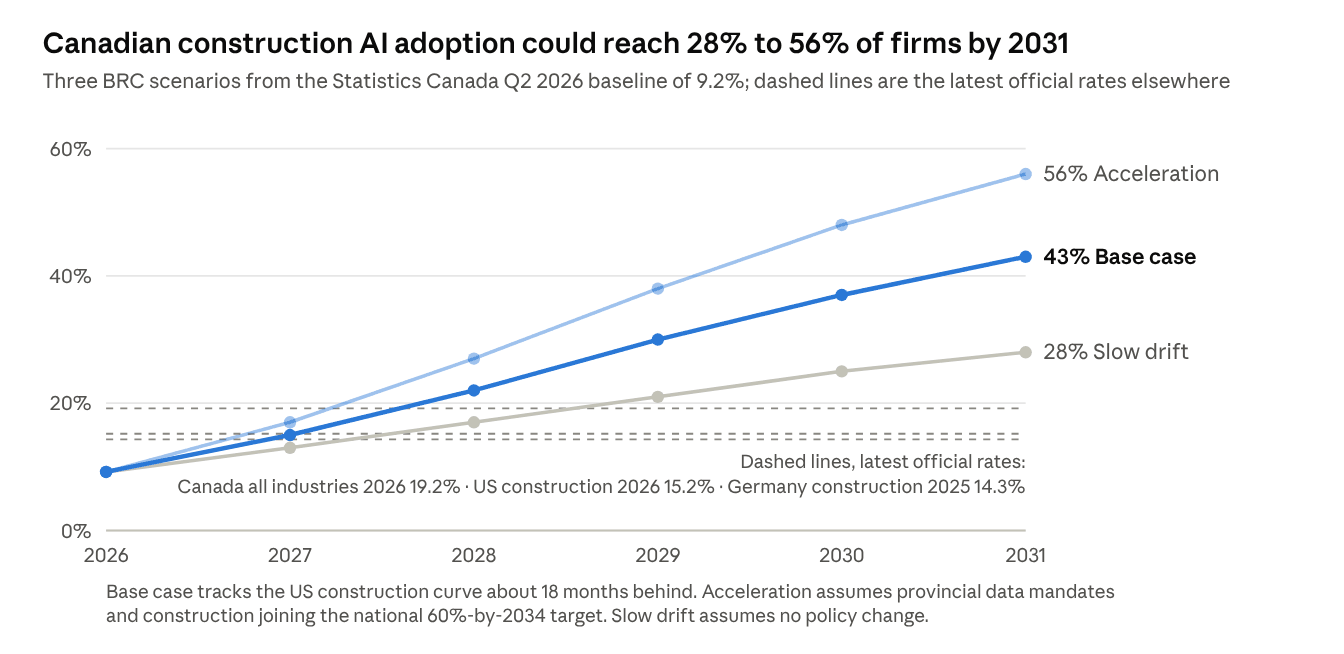
- 28–56%of firms using AI by 2031, across three scenarios
What the report finds
Canada will spend more than $700 billion of public capital on construction over the next decade, with an industry in which 9.2% of firms use AI, residential productivity has fallen 37% since 2001, and the workforce’s entrant pipeline is shrinking. This report sets out what AI is doing in construction today, how Canada compares with the United States, China, Japan and Germany, and what Canadian owners should do before the 2028–2029 spending peak.
Five findings
- Canada is last among the countries that measure. 9.2% of Canadian construction firms use AI, against 19.2% across all industries: a ratio of 0.48, behind the United States (0.66) and Germany (0.55).
- AI is proven where the work is documents and data. AI takeoff, contract review, camera-based progress tracking and predictive maintenance are scaled products. Site robotics is still in pilots, with no published productivity ratio.
- Only Japan measures the results. Contractor surveys there show ICT earthworks cutting labour hours by 34% (n=382), and procurement took ICT from 36% to 93% of eligible national public works in nine years.
- The owner’s prize is change orders and error costs, not software savings. Hydro-Québec’s change-order cost was 3.6% on a BIM-delivered project, against 15–18% on traditional ones. A two-point cut across the public pipeline is worth about C$14 billion over its life.
- Canada’s gap is policy, not talent or capital. Construction is missing from the June 2026 National AI Strategy, and Canada has no AI statute, no federal BIM mandate and no AI clauses in its standard contracts.
The outlook to 2031
On the base case, Canada tracks the United States about 18 months behind and reaches 43% construction AI use by 2031, with a 3–5% whole-project productivity gain: the equivalent of 15,000–25,000 workers. If two or more provincial owners adopt Japan’s procurement ladder before the 2028 peak and the federal strategy adds construction, adoption reaches 56% and the gain roughly doubles. If nothing changes, it reaches 28%.
What owners should do now
- Write ISO 19650-style information requirements, a common data environment and AI supplementary conditions into every 2026–2027 contract. The CCDC forms are silent on all three.
- Baseline RFI cycle time, change-order rate, rework and schedule variance before deploying any tool.
- Deploy the proven lane first (document intelligence, AI takeoff, site capture, delay-risk forecasting) and leave site robotics to contractors.
The full report sets out 17 recommendations for owners, contractors and policymakers, a phased 2026–2031 roadmap and what each action costs.
Inside the report
- Executive summary
- 1. Introduction, scope and methodology
- 2. The Canadian construction industry today
- 3. What AI means on a construction project
- 4. AI adoption in Canada: the current state
- 5. Benchmark: United States
- 6. Benchmark: China
- 7. Benchmark: Japan
- 8. Benchmark: Germany
- 9. Comparative scorecard: Canada against the four benchmarks
- 10. Measured impact: what the evidence supports
- 11. Five-year outlook for Canada, 2026–2031
- 12. Risks, barriers and governance
- 13. Implications for owners and owner's representatives
- 14. Recommendations and a 2026–2031 roadmap
- 15. Conclusion
- Appendices
9 figures, 14 tables and more than 190 linked sources, current to 23 October 2026.
About the author
Ben Abbasi, PMP, is Founder and Principal of Benjamin R. Consulting Inc. and owner’s representative on a multi-building corporate campus program in Toronto, with more than 12 years managing complex, long-duration projects. He teaches planning and scheduling at George Brown College.
Have a program that's slipping, or about to start?
Book a 30-minute call. We'll tell you where your schedule and budget are exposed, and what an owner's rep would change, before you commit to anything.